

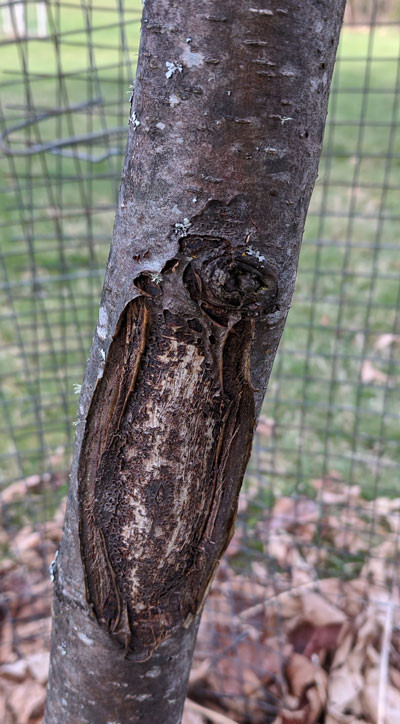
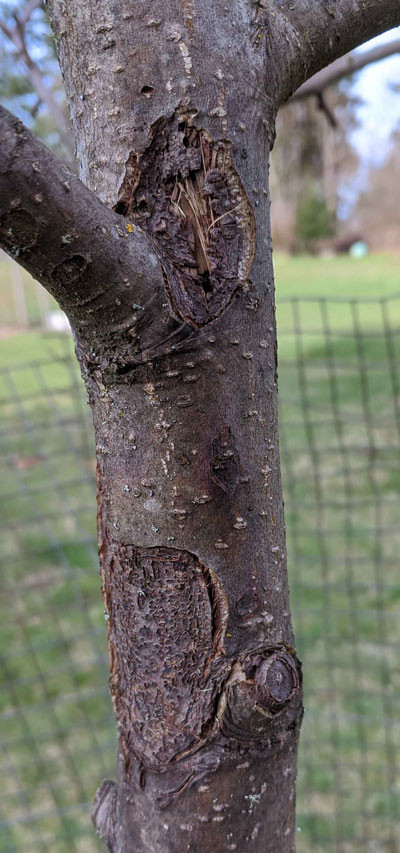
I have attempted to attach some photos, and I'm hoping someone more knowledgeable than I am can identify what's wrong with my 2 honeycrisp trees. Is it bacterial, fungal, sunburn...something else?
We have 2 honeycrisps and the trunks both have the same bark separation issue going on. The trees were both planted Feb. 2015, and purchased bare root from Costco. They are semidwarf, and the rootstock was not labelled. We purchased 3 other apples at the same time, but the bark on those trees looks fine. I sprayed both these trees with horticultural oil in March 2019 and March 2020. I think I first noticed this bark separation issue in 2018? I can't remember for sure. The branches on both trees look fine, so this is just an issue on the main trunk.
Any help or advice is greatly appreciated.
Thanks,
Clarice


I forgot to mention that both trees have been producing apples for 3 years--just a few on each tree in 2017, more in 2018, and both had good crops in 2019.
Clarice
My guess is that it's anthracnose. Other, more experienced, members may have another suggestion or better idea.
My Akane on M.26 rootstock developed anthracnose a couple of years ago, and the damage on your trees looks similar. I cut out at least half of the tree, then used my version of tree paste on the wounds and infected areas that I couldn't remove. Last summer it produced a couple of dozen apples, and there were no additional diseased areas; but this summer should give me a better idea if it's going to survive.
My biggest concern was (should have been) in preventing the spread of the disease to other trees. So far that hasn't happened, and I add tree paste periodically to ensure that the wounds stay covered. In retrospect the Akane probably should have been removed immediately and the diseased wood destroyed. It seems to me that this may be more of a gamble than it's worth - one tree versus how many more trees in my orchard?
If you want to try the tree paste instead of immediately cutting down your trees, this is my modified version: compost, coarse sand, and Surround or another clay, mixed with just enough water to form a paste. On a rainless day coat every diseased area or wound with the paste.
I hope that more experienced orchardists will weigh in with their opinions, both in what they think it is and also how best to deal with it.
GH said
My guess is that it's anthracnose. Other, more experienced, members may have another suggestion or better idea.My Akane on M.26 rootstock developed anthracnose a couple of years ago, and the damage on your trees looks similar. I cut out at least half of the tree, then used my version of tree paste on the wounds and infected areas that I couldn't remove. Last summer it produced a couple of dozen apples, and there were no additional diseased areas; but this summer should give me a better idea if it's going to survive.
My biggest concern was (should have been) in preventing the spread of the disease to other trees. So far that hasn't happened, and I add tree paste periodically to ensure that the wounds stay covered. In retrospect the Akane probably should have been removed immediately and the diseased wood destroyed. It seems to me that this may be more of a gamble than it's worth - one tree versus how many more trees in my orchard?
If you want to try the tree paste instead of immediately cutting down your trees, this is my modified version: compost, coarse sand, and Surround or another clay, mixed with just enough water to form a paste. On a rainless day coat every diseased area or wound with the paste.
I hope that more experienced orchardists will weigh in with their opinions, both in what they think it is and also how best to deal with it.
Thank you for your response. If the trees are afflicted with anthracnose, it's a pretty difficult thing to get rid of, isn't it? When do you recommend I try cutting out the damage? I'm assuming after our spring rains are over? I would like to at least attempt to salvage the trees, since we're really happy with the apples the trees have produced so far.
MNtransplant said
If the trees are afflicted with anthracnose, it's a pretty difficult thing to get rid of, isn't it? When do you recommend I try cutting out the damage? I'm assuming after our spring rains are over? I would like to at least attempt to salvage the trees, since we're really happy with the apples the trees have produced so far.
I have heard of but not tried; scraping the diseased area to sound wood then cauterizing the wound with a torch. It might be another approach to consider.
I read about cauterizing trees online. It might be worth trying on one of the trees at least.
Thanks for chiming in!

The approach that I use in this situation is biodynamic tree paste. Mix it up, paint it on, and let the tree heal.
https://earthhaven.ca/blog.php.....Tree-Paste
http://groworganicapples.com/p.....,1711,1711
https://cdn.shopify.com/s/file.....5095028812
John S
PDX OR