

I planted this Ashmead's Kernel tree in autumn of 2014. I'm in Portland, Oregon, where we had an intensely hot, dry summer last year followed by a very wet winter and spring this year. Last summer or fall, the bark on this tree started cracking and peeling. I thought it was just growing, but the crack looks worse now, and the tree doesn't seem to have grown as much as my other fruit trees. Two branches near the cracked bark seem to have died, but the rest look okay, with vibrant leaves and lots of blossoms. Can any of you tell me what this might be? Thanks!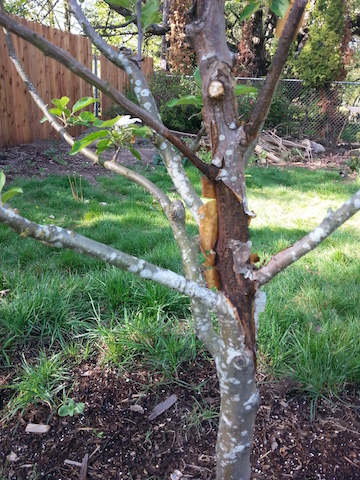

Looks like apple Sunscald. Search it, and compare the images. Horizontal exposed limbs on established trees are vulnerable, too...
I had cut ‘white’ corrugated plastic drain line down one side, then ‘carefully’ placed it around the trunks of my young trees. Though it makes a nice home for insects and mice ... it also reflects and protects the young trunks from sun or physical damage.
There are ‘tree-wraps’ that likely do the same, but my concern was having to remove and/ or ‘rewrap’ them as the trunk girth expanded each year.
Or, I’d also painted my tree trunks with ‘Interior’ cheap white latex paint (it’s slowly coming back to me  ) - That’s what I’d suggest. It reflects sunlight, inhibits insect feeding (their first bite being latex paint), and makes the young trees more visible.
I'd 'pull up' and tie those lower limbs to each other, training them as the new main scaffold limbs. It'll make for a very low-branched tree, but apple trees are resilient and lend themselves well to such character
So, I'd saw out the center portion above the 4 non affected branches, tie them to each other to bring them to a slightly higher angle, paint the wound/s, and see how it does this season...

Viron said
I'd 'pull up' and tie those lower limbs to each other, training them as the new main scaffold limbs. It'll make for a very low-branched tree, but apple trees are resilient and lend themselves well to such characterSo, I'd saw out the center portion above the 4 non affected branches, tie them to each other to bring them to a slightly higher angle, paint the wound/s, and see how it does this season...
That sounds good, but I only see one branch that is not affected.
jafar said
Viron said
I'd 'pull up' and tie those lower limbs to each other, training them as the new main scaffold limbs. It'll make for a very low-branched tree, but apple trees are resilient and lend themselves well to such characterSo, I'd saw out the center portion above the 4 non affected branches, tie them to each other to bring them to a slightly higher angle, paint the wound/s, and see how it does this season...
That sounds good, but I only see one branch that is not affected.
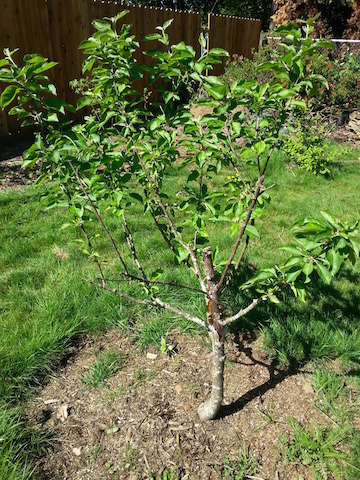
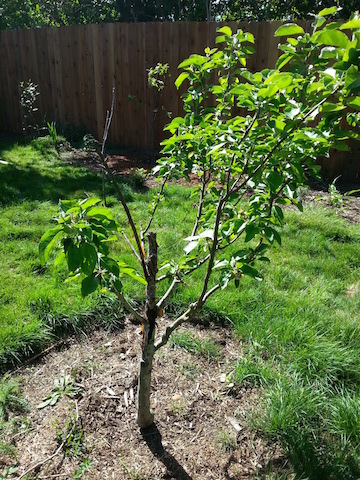
There are several unaffected branches, but the side of the tree where the damage started has no healthy branches anymore. The peeling bark is making its way around the whole trunk now, but most of the branches still look okay.
jafar said
Ah, I see the confusion. What I meant was, it looks like there would be, at most, one branch left were you to cut the trunk at a location such that all of the damaged bark was removed.
Oh, yes! You're right. Sorry, I misunderstood. I'm feeling like I might just have to replace this tree, which stinks because it's one of my favorites. At least it's a good learning experience, though. I'll definitely be protecting the trunks of all my young trees next winter!
I wouldn't expect sunscald to be too severe in Portland OR, the climate there is rather mild. Sunscald is more common in colder areas where the bark on the south side of the tree warms up in the sun during the day and refreezes at night. Judging from the shadow on your wide angle photo, your problem encircled the whole tree.
Have you ruled out anthracnose as the problem? If it is anthracnose the tree isn't worth saving. I had an apple tree with anthracnose that I kept cutting back and trying to graft new scion onto but disease kept killing off the branches I grafted. Disease girdles the branch under the bark and soon the whole branch dies.
It doesn't look, to me, like most pictures of anthracnose I found while googling just now, but I'm certainly no expert. Nothing under or around the peeling bark appears to be rotting, and there are no "fiddle strings" of bark fiber. And the leaves look healthy. It's possible, though. Maybe my best bet is to cut it back, but also plant a replacement tree nearby so that if this one dies, at least I'll have a head start on growing another.
Yah, that could be Anthracnose… My experience with it had been no worse than the ‘football shaped lesions’ on branches, and rarely young trunks. I know some trees are more susceptible, perhaps the Ashmead here is one of them..?
It’s a tuff call from photos, but as mentioned, there’s a lot of energy (as well as perhaps virus) stored in it’s roots … and a shame to remove it and start over. And, if it’s Anthracnose ..would it be safe to plant another apple in it’s place 
I’d bend up the largest and strongest limb, really tying it over hard to as vertical as possible, see if that establishes a 'new trunk' ...and if it snaps, try another.. If it grows well this season, give it another. If not, plan for it’s replacement, either a potted ‘something,’ or a bareroot next Spring.
That’s how orcharding's gone for me, seemed every ‘original tree’ got replaced by a couple more, until one worked
My opinion? I have a formerly robust 30 year old Spitzenberg, now crippled by the same malady. I assumed the problem was Anthracnose. On my tree, due to location on trunk, Sunscald is unlikely. Looks like I'm finally gonna have to break down, and dormant spray my trees.
The problem is the current air quality in Portland; it's too damned good. Years ago, Katy Emerson of Emerson Nursery, informed me that there was enough Sulfur in Portland air, to naturally suppress the infective agent.... While just across the St. Johns Bridge in pristine St. Helen's, spraying was required.
For decades, that statement appeared to be true. Apple trees in residential Portland, had few diseases. And, my largely neglected children, suffer no serious problems. About 7 to 10 years ago, I finally noticed trunk damage. Eventually it completely girdled a major portion of the tree, and it now appears that the tree is beyond salvation. No fresh damage, but so much of the tree's wood has now rotted away, that it is certain to topple over within the next few years.
Might as well get started on a new tree. Possibly a tree that is less disease prone than Spitzenberg. My nearby Ashmead"s Kernel, has had no major problems, other than insects considering it the most delectable of all apples. The bugs love it so much, that they pretty much leave my Spitzenberg alone.
Note: Perhaps a decade ago, Portland buses stopped using regular Diesel (a source of Sulfur), in favor of Biodiesel.
John S said
I have a SPitzenberg apple tree with no problems. I think it probably is a disease, very likely anthracnose if these smart people think it is. I would apply biodynamic tree paste. I think it's a much better solution than hacking the tree.John S
PDX OR
I've no experience with , but heard from various sources the efficacy of the biodynamic tree paste for at least a few various maladies.
Also no experience with but was recommended to try, before my Cox Orange Pippen had succumbed; cleaning out, scraping the spongy- affected tissue. Then cauterizing the wound. Might buy some time.
Incidentally , where the Cox was, there is a rootstock sucker (only one emerged) now two years old, with no apparent lesions. I might try grafting on, providing cutting the 2'X6" stump off doesn't have me damaging the whip .
.
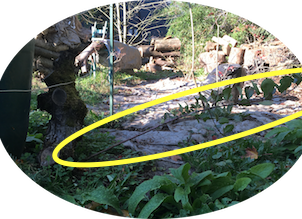

With the new view of the dead upright branch where the rest is green and lush, I would guess a disease. I became interested in Compost tea when I had $400 worth of plants that were black and dying. I sprayed them with it and voila, green lush growth again. Problem solved. That's what I would do.
I think in the long run, you will learn enough healthy orchard practices that will prevent these problems. Problem prevented or minimized.
John S
PDX OR
Well, if it is Anthracnose.... Manhart suggests removing the dead bark, and brushing the affected and surrounding area, with a strong CopperSulfate solution. Claims this worked for him. Stops the spread. Sadly, I haven't yet found reference to what Warren considered a "Strong" CopperSulfate solution.
Idyllwild
jafar
Marsha H
Viron
1 Guest(s)